AI Knows the Market. It Doesn't Know You.
Last week. Lunch with Sushobhan near Basel.
We're eating Pissaladières—the French onion tart that's better than it sounds—and he's telling me about Davos.
Sushobhan comes from financial media. Spent years in it. He'd just come back from the World Economic Forum.
I asked what it was like.
He smiled. The kind of smile that says "you're not going to like this."
"Every panel spot is purchased, Roy. Companies pay six figures to put their executives on stage. The entire business model is narrative creation. Then the press—hundreds of journalists sitting there—takes those narratives and amplifies them for weeks. That's the product. Not insight. The narrative."
I stopped mid-bite.
Because I'd been consuming those narratives for years. As if they were guidance. As if they had anything to do with my life.
And here's the uncomfortable realization:
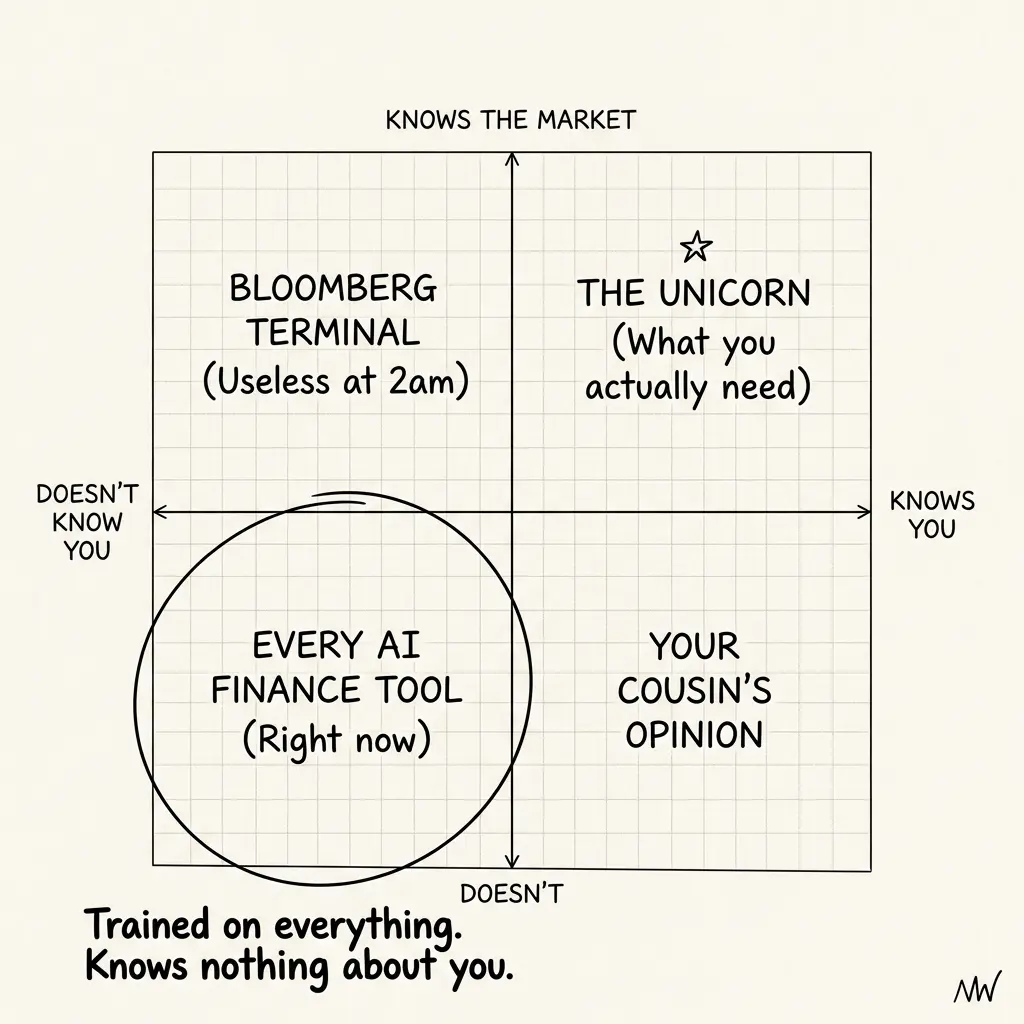
AI doesn't fix this. It makes it worse.
The Outside-In Machine
Open the FT right now. Bloomberg. CNBC. LinkedIn finance influencers.
# You'll see:
→ "Markets hit all-time highs"
→ "Inflation expectations ease"
→ "Tech leads the rally"
→ "Emerging markets poised for breakout"
These aren't lies. They're data points.
But they're macro. Aggregated. Abstracted.
GDP can grow while your wages stagnate. Markets can soar while your balance sheet weakens.
The S&P hitting new highs tells you nothing about whether you should sell your RSUs, refi your mortgage, or keep cash for your parents' care home.
National success ≠ personal progress.
But here's what happens: We consume these narratives as if they were personal guidance. We read "markets are up" and think: I should be investing more aggressively.
The outside-in lens feels like clarity. It's actually distortion.
Why AI Makes This Worse
ChatGPT is brilliant. Ask it: "Should I invest in bonds or equities right now?" It'll give you a coherent, well-reasoned answer about interest rates and risk-return trade-offs.
All true. None of it about YOU.
AI operates from the outside-in. It knows what the market is doing. It knows what historically worked for aggregated cohorts.
- → Your equity vesting schedule
- → Your parents' declining health
- → Your spouse's risk tolerance
- → That deed to property in India...
The problem isn't that AI is wrong. It's that
it's answering a different question than the one you're actually asking.
The Inside-Out Lens
Outside-in asks: What is the market doing?
Inside-out asks: What is my life asking of my money right now?
"Wealth is personal before it is financial. The market doesn't know your kids, your mortgage, or your sleep schedule. So why are you benchmarking against it?"
NettWorth: The Inside-Out layer AI is Missing
When you give AI your context—your actual numbers, your actual constraints, your actual life—suddenly it becomes useful.
The Difference
Generic AI: "IPOs are volatile. Consider your risk tolerance."
NettWorth: "You have 10,000 shares vesting. At $30, that covers your down payment. Sell 70% now. Secure the home."
NettWorth isn't another portfolio tracker. It's the inside-out layer that AI is missing. We structure your financial reality so AI can finally shift from "What do markets think?" to "What should YOU do?"
If This Lands
If you're tired of outside-in advice and ready for inside-out truth— DM me.
I'm 3 weeks from alpha. Building this for people who are done with motivational fluff and ready for reality.
— Roy
NettWorth
Wondering how to act on the insights in the article? Click here to apply this framework to your own wealth portfolio.
NettWorth reads your actual documents and applies what you just learned to your specific accounts, balances, and timeline — not a hypothetical.
No charge if you cancel. Your data stays yours.
Continue Reading
You Didn't Earn This Money. That Doesn't Mean You'll Lose It.
The feeling that you're not the kind of person who has this much money is extremely common after inheriting. It doesn't make you reckless — it makes you frozen. And 18 months in a money market fund while you 'figure it out' is a real financial cost, not a safe choice.
Burned Out at $400K With $2M in the Bank. What Would People Like You Actually Do?
Karan messaged at 2pm on a Tuesday — during work hours. He has $2.1M and earns $410K. He's not asking if he can afford to leave. He knows that. He's asking what people in his exact financial situation actually chose, and how it went.
Income vs. Wealth: Why $500K Salary Doesn't Guarantee Wealth
Same $500K salary, vastly different wealth by age 55 ($3M-$5M gap). The difference isn't investing skill—it's spending discipline. Optimize for the right variable.