Cross-Border Wealth Library
Specific answers for international financial lives: Americans abroad, H-1B and NRI planning, FBAR, FATCA, PFIC, RSU sourcing, foreign pensions, relocation corridors, and the decisions that sit between two tax systems.
83 articles
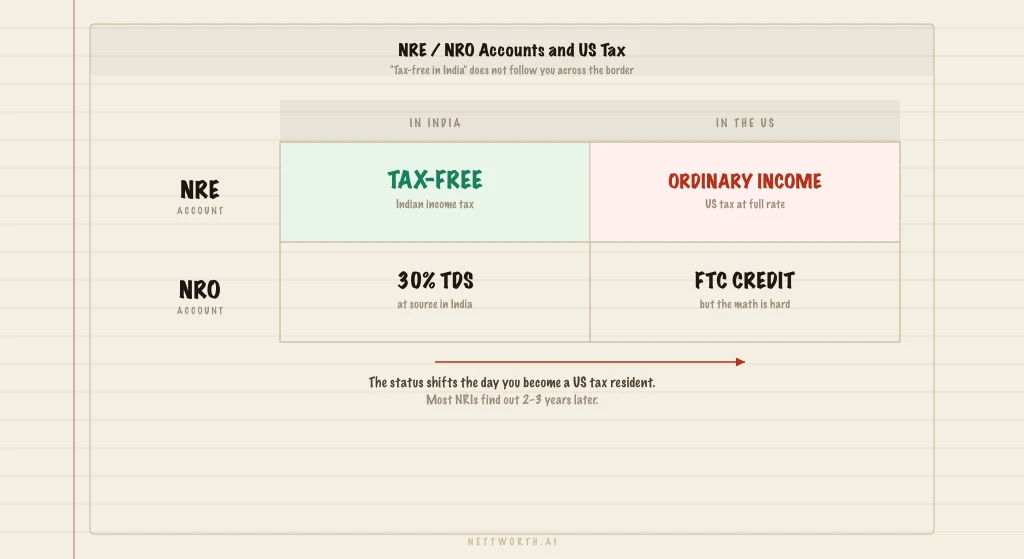
NRE and NRO Accounts: What Changes the Day You Become a US Tax Resident
NRE interest is tax-free in India. The day you become a US tax resident, it becomes US taxable income at ordinary rates — and most NRIs find out two or three years late. NRO interest has a different problem: 30% TDS generates a Foreign Tax Credit, but the credit math depends on your US bracket. FBAR applies to both accounts from year one. The gap exists because the Indian CA says 'tax-free' and the US CPA never asks.

Before You Leave the US for the Netherlands: The 30% Ruling Doesn't Do What You Think It Does
Sarah moved from New York to Amsterdam and was excited about the 30% ruling. Then her US CPA explained: the ruling reduces Dutch income tax — which reduces the Dutch foreign tax credit she can apply against her US liability. In some income bands, the US takes more, not less. And the ruling application window is exactly 4 months from day one. Miss it permanently.
Before You Leave the US for Germany: Tax Class, the Solidarity Surcharge, and Your 401K
Marcus moved from San Francisco to Berlin expecting the US-Germany treaty to sort out the coordination. His Steuerberater explained: there's no mechanism equivalent to the US-Canada RRSP provision deferring 401K taxation. Distributions are taxed in Germany at up to 47.5% minus the US withholding credit. And if his HR form asks his religion — that's for Kirchensteuer.
Before You Leave the US for Australia: What to Do About Your Super and Your US Accounts
Emma asked her Australian financial planner how to transfer her 401K into her super fund. He'd seen this question before. The answer: you can't. The US doesn't allow rollovers to foreign retirement plans. Australian super is likely a PFIC. The only viable path: leave the 401K in the US and manage two retirement systems in two countries.
Before You Leave the US for Canada: The RRSP Question and Everything the Treaty Doesn't Cover
Michelle opened a TFSA in Toronto because her colleagues said it was like a Roth IRA. Her US CPA explained: the IRS doesn't recognize the TFSA wrapper. Gains are fully US-taxable. It may require PFIC or foreign trust reporting. She closed it before year end. The compliance work cost more than the TFSA earned.
Before You Move to the US from Europe: The Financial Checklist for German, Dutch, and French Professionals
Thomas had been contributing to his German bAV for nine years. His cross-border accountant explained: Germany's pension tax deferral is a German decision. The US didn't agree to it. His employer's contributions were still taxable US income in the year contributed. Three countries, one checklist.
Before You Move to the US from the UK: What to Do with Your ISA, Pension, and NI Record
James had a Stocks and Shares ISA worth £80,000. He moved to San Francisco on an L-1B and assumed the ISA tax-free wrapper followed him. His US CPA was direct: the IRS does not recognize the ISA. The gains that accrued tax-free in the UK are US-taxable as ordinary income.

Before You Move to the US from China: Your Financial Checklist
Wei assumed his Chinese A-share brokerage account was invisible to the IRS. What he hadn't read: China joined the Common Reporting Standard in 2018. His bank had been automatically reporting his account to the Chinese tax authority, which shares with the IRS. Before you become a US resident alien, you need to know what this means for your accounts.
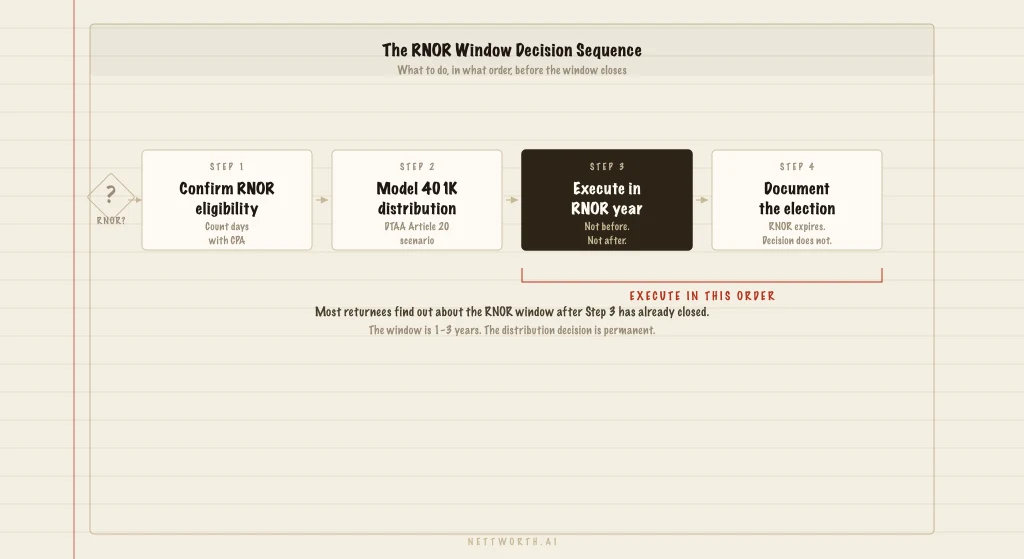
You're Returning to India. Your RNOR Window Is Open. Here Is the Exact Sequence of Decisions.
Sunita returned to Bengaluru and knew about the RNOR window. Her CA explained the sequencing options. She had all the information. Nobody had synthesized it into a sequence. The difference between taking 401K distributions during RNOR versus after: 10% effective rate versus 30%+. On $200K of distributions, that's $40,000.
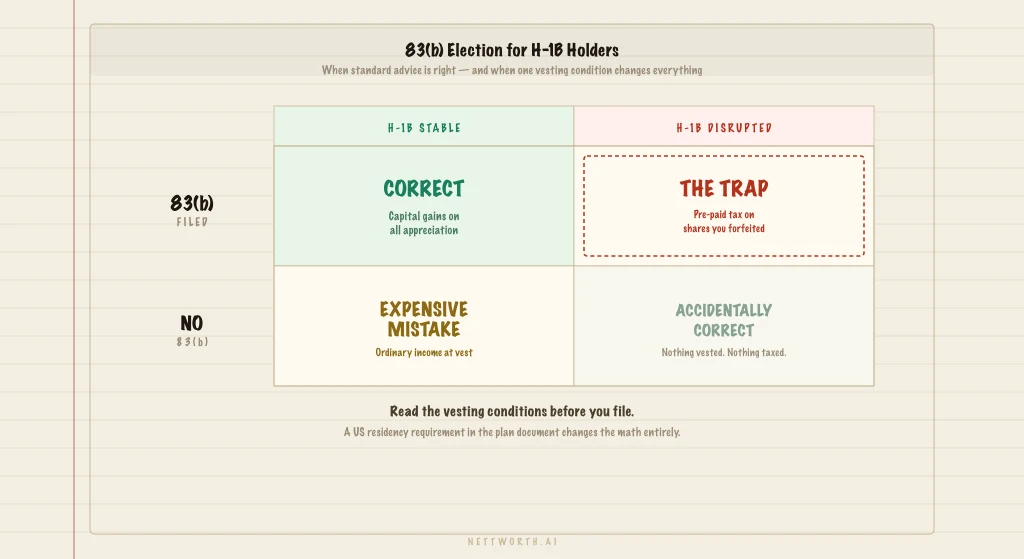
The 83(b) Election When You're on an H-1B: The Startup Advice That Doesn't Account for Visa Risk
Wei filed the 83(b) on 500K shares at $0.02 — the tax bill was $300. Two years later the company hit $4/share. Then his H-1B renewal was denied. His equity plan had a US residency vesting requirement. He'd pre-paid $300 in tax to secure shares he could no longer hold. The 83(b) is usually the right move. Read the plan document first.
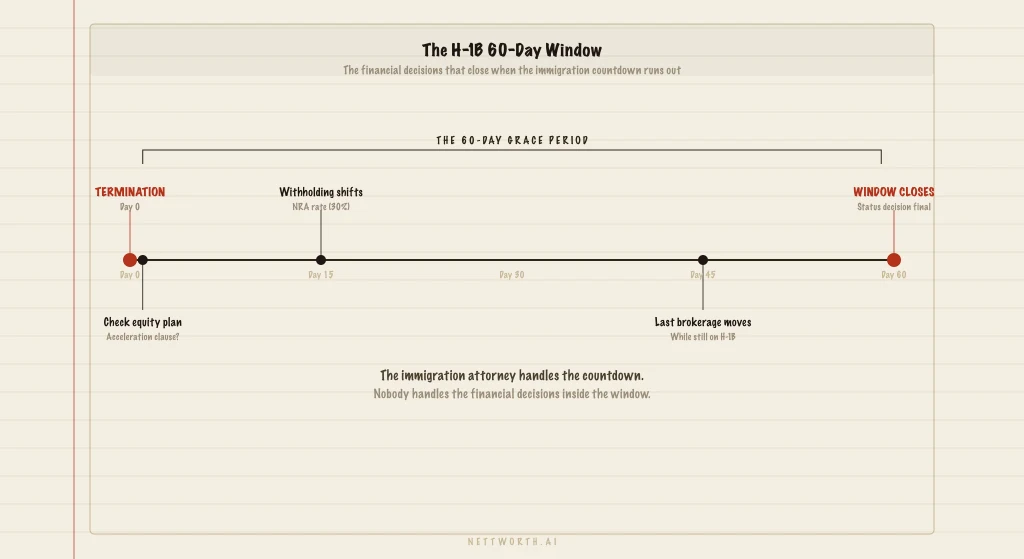
Your H-1B Is In Transfer. You Have 60 Days. Here Is What To Do With Your Money.
Kevin got the layoff message Thursday at 4pm. He called his immigration attorney immediately. He didn't call anyone about his financial situation. Six months later: a corrected W-2 with 30% NRA withholding on RSUs he hadn't known had accelerated. The 60-day grace period is also a financial window. Nobody told him.
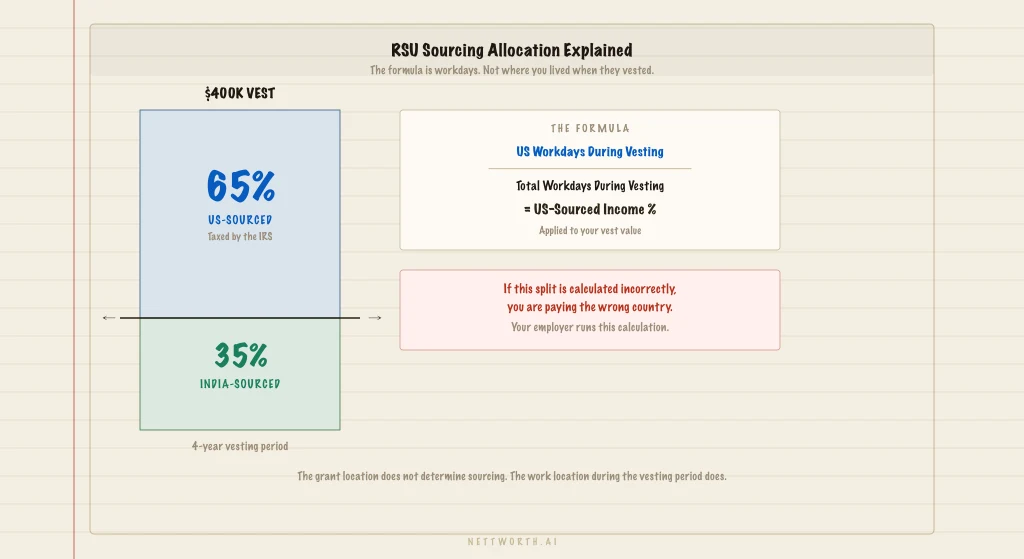
RSU Sourcing: How Your Workdays Between Grant and Vest Determine Your Tax Bill Across Two Countries
Ananya's RSU grant was in Bangalore. By year two she was in San Francisco. The W-2 showed Box 1 income she didn't understand. Her tax preparer pulled out a workday ratio. US workdays divided by total workdays in the vesting period equals the US-taxable portion. Ananya had never heard of sourcing allocation before that conversation.