RSU Sourcing: How Your Workdays Between Grant and Vest Split the Tax Across Two Countries
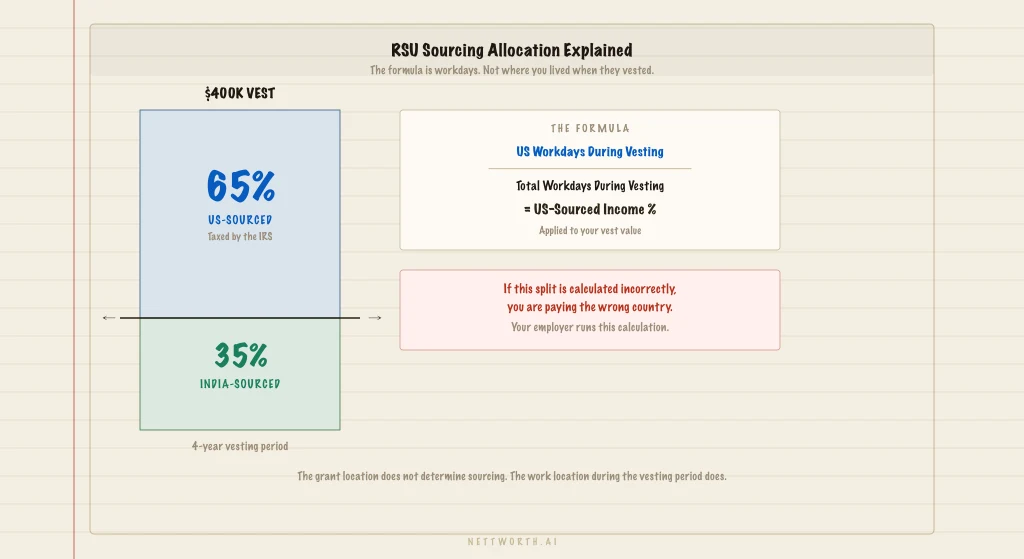
RSUs don't belong to the country you live in when they vest. They belong, in shares, to every country you worked in while you were earning them.
Take a grant made while you worked in Bengaluru that vests a year after you started in Amsterdam. Or a grant from your Paris years that vests after a move to Munich. The vest shows up on your new payslip as one number, taxed as if all of it were earned where you now live. Your old country sees it differently, and so, eventually, will your new one.
The Rule: Workdays Between Grant and Vest
The OECD's commentary on the employment article of its Model Tax Convention treats income from employee equity as pay for the work done between the grant and the vest. When that work happened in more than one country, the income is split by workdays: the days you worked in each country during the vesting period, divided by the total.
Most Western European tax authorities follow that approach, and some have written it into law. Switzerland's federal direct tax act (Article 17d) taxes equity income in proportion to the part of the vesting period spent working in Switzerland when you weren't resident there for all of it. Germany's finance ministry applies the same grant-to-vest period in its guidance on employment income under tax treaties. India, for its part, taxes RSUs when the shares are allotted, and keeps a claim on the share earned by work done in India after you have left.
Why the vest date alone is the wrong test
A four-year grant vesting in equal parts carries a different split on every vest. The first tranche after a move may be mostly earned in your old country. The last one may be almost entirely in your new one. Each tranche needs its own calculation, and the move date matters more than the vest date.
Payroll Will Probably Get It Wrong
Payroll systems are built for one country. Your new employer's payroll will usually withhold on the whole vest as local income. Your old employer's payroll, or your old country's tax office, may not withhold anything, and still expects its share on a return. Assume that in the year you move, nobody's withholding matches the split, and that both countries will only be reconciled on your returns.
Large employers with a mobility team often do run a workday allocation. Many don't, and the ones that do can only use the travel and location data they have. If you spent three weeks of the vesting period working from your old office, or worked remotely from somewhere else, the payroll split won't know unless you told someone.
Keep your own workday log
The split is only as good as the record of where you worked on which days. Calendars, travel bookings and entry stamps reconstruct it after the fact, badly. A simple log kept from the day you accept a move is the evidence both countries will ask for, and it covers every unvested grant you hold.
How the Double Tax Gets Removed, and When It Doesn't
When two countries tax the same vest, the treaty between them decides which one gives way, usually through an exemption or a credit in the country where you now live. The Netherlands and Germany generally exempt foreign-sourced employment income and use it only to set the rate on the rest. Relief of this kind is claimed on a return, against evidence that the other country taxed or was entitled to tax its part.
What goes wrong in practice is timing. India's tax year runs April to March, Europe's mostly January to December. A vest can fall in a year where you were resident in both, in neither, or in one country for tax and the other for payroll. The double tax is usually recoverable. The cash withheld twice is gone until both returns are filed and processed, which can take more than a year.
What to Ask Before the First Vest After a Move
- Does my employer apply a workday allocation to vests after a move, and on what data?
- Which country's payroll is withholding on which part of each tranche?
- Is there a tax equalisation policy, and does it cover equity or only salary?
- Which tax year in each country does each vest fall into?
Ask in writing, before the first vest after the move. Fixing a split before the payroll run is an email. Fixing it afterwards is two returns and a refund claim. The wider set of decisions around a move is in the checklist for moving to Europe.
Do you know how much of your next vest each country can claim?
A blog post can tell you the rule. It can't tell you what it means for your accounts, your dates, your numbers. That's a conversation, not a search result.
Book a call and get answersNettWorth
Wondering how to act on the insights in the article? Click here to apply this framework to your own wealth portfolio.
NettWorth reads your actual documents and applies what you just learned to your specific accounts, balances, and timeline — not a hypothetical.
No charge if you cancel. Your data stays yours.
Continue Reading
Moving to Europe: The Financial Checklist for the 90 Days Before You Leave
Whether you are coming from Bengaluru or moving between European countries, the decisions with deadlines come before the move: when your tax residency changes, RSUs that vest after you arrive, Indian accounts that must be redesignated, the Dutch 30% ruling's four-month window, social security certificates, and the health insurance gap.
The 83(b) Election When You're on an H-1B: The Startup Advice That Doesn't Account for Visa Risk
Wei filed the 83(b) on 500K shares at $0.02 — the tax bill was $300. Two years later the company hit $4/share. Then his H-1B renewal was denied. His equity plan had a US residency vesting requirement. He'd pre-paid $300 in tax to secure shares he could no longer hold. The 83(b) is usually the right move. Read the plan document first.
Before You Leave the US for Singapore: What FEIE Doesn't Cover and What You Need to Do
Jason took the Singapore role thinking he'd finally escape US tax on investment gains. Singapore has no capital gains tax. He assumed his RSUs would be covered by the Foreign Earned Income Exclusion. His US CPA: RSUs are compensation, not foreign earned income. FEIE doesn't apply. You owe US ordinary income tax on every vest.