Concentrated Tech Equity: The Diversification Decision (With Math)
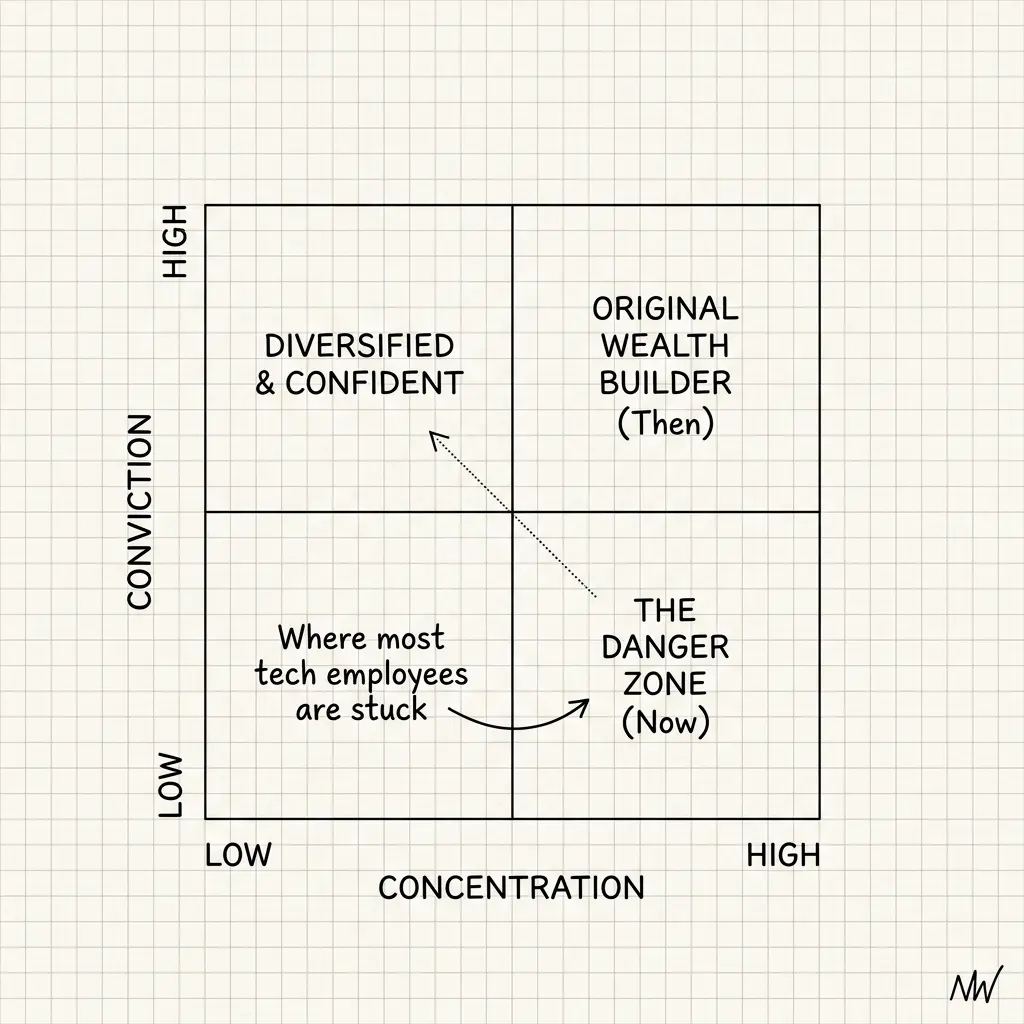
Your advisor says diversify. But diversification has a real cost. Here's the math on when holding wins, when selling wins, and what wealthy founders actually do.
Your lockup expires next month. You have $2M in SpaceX equity. It's been illiquid for years. You've watched it appreciate. You've built your entire post-exit lifestyle assumption around that number. Maybe you've already mentally spent it. (Everyone does.)
Then your advisor calls. "You need to diversify. Concentration risk is too high." And you know they're right. Except they're not. Not entirely. The advice is true but incomplete. The real question isn't "should I diversify." It's "when should I diversify, and how much."
Because here's the thing conventional advisors miss. Diversification has a cost. And that cost might be larger than the concentration risk you're trying to avoid.
The Math Everyone Gets Wrong
Let's say your $2M SpaceX stake is worth $2M today. You bought it at $0.10/share via options. Current valuation. $100/share. (Rough numbers, real scenario.)
Scenario A: You do nothing. You hold. SpaceX goes public in 3 years at $150/share. Your $2M becomes $3M. After taxes (long-term capital gains at 20% federal, 3.8% NIIT, state tax). You net roughly $2.3M.
Scenario B: You diversify immediately. You sell $1M today. You pay short-term capital gains (50% unrealized gain). $500K gain. At 37% federal plus state. You owe roughly $190K in tax. You net $810K to invest in diversified portfolio. Now you have $1M in SpaceX (still concentrated) and $810K in diversified index funds.
The index funds grow at 7% real return over 3 years. $810K becomes roughly $990K. Your $1M SpaceX grows to $1.5M over 3 years. Total: $2.49M. After taxes on the remaining SpaceX sale when it goes public. You net roughly $2.0M total.
Scenario C: You hedge instead of selling. You use a collar strategy. You own the $2M upside above $110/share but cap gains above $150/share. Cost of hedge. $50K. Net cost after tax benefit. $35K. SpaceX goes public at $150/share. Your cap is hit. You make $2M plus the upside above $100 (your cost basis) to $150 (your cap). That's roughly $2.4M gross. After taxes on the original gain and the hedge cost. You net roughly $1.95M.
Which Scenario Wins?
Hold: $2.3M net. Diversify: $2.0M net. Hedge: $1.95M net. Holding wins. By $300K. Over a 3-year period.
But here's the catch. That assumes SpaceX actually goes public at $150+. What if it goes public at $80/share (still profitable, but founders took longer). Your scenarios flip. Hold: $800K net (ouch). Diversify: $2.0M net (suddenly looking smart). Hedge: You're protected at $150 cap (you actually made $1.95M).
The Real Decision Framework
The conventional "diversify" advice is right for one scenario. The scenario where you're uncertain about the company's future and you want downside protection. The "hold" strategy is right if you have conviction. Not hope. Not sentiment. Conviction. Based on what.
Your conviction should answer these questions:
- Do you know the company's revenue trajectory better than the market.
- Are you willing to lose the entire $2M if you're wrong.
- Can you sleep if it drops 50% in value tomorrow.
- Do you have 5+ years of runway outside this $2M. (Important. If this is your only wealth, you must diversify regardless of conviction.)
Most people can't answer "yes" to all four. If you can't. You should diversify, taxes be damned. Because the psychological cost of watching $2M become $500K while you hold is worse than the tax cost of selling.
The Timing Window
Here's what most people miss. The lockup expiration creates a timing window. After the lockup expires, you have optionality. You can sell over time (reduces market impact, spreads tax liability). Sell tranches at different price points (tax-loss harvesting on any decline). Hold and re-evaluate quarterly (lower regret on forced decisions). Use options strategies (collars, puts, call spreads).
During the lockup, you have zero optionality. So the lockup expiration isn't a deadline to make a decision. It's the moment your decision-making power returns. Most advisors treat it backwards. They see the expiration date and panic. "You must decide now." Wrong. You're about to gain the ability to decide carefully.
What Wealthy Tech Founders Actually Do
I asked four founders (SpaceX, Stripe, Anthropic, a unicorn that didn't exit yet) what they do with concentrated equity. The pattern: They don't diversify all at once. (They've seen others blow up on single-day sales.) They sell in tranches. (Psychological permission. Tax optimization. Market-impact reduction.) They keep some. (Optionality. Upside participation. Sometimes it's just emotional attachment.) They use options for downside protection. (Collars are underutilized.)
The exact allocation varies. But it's never "diversify now" or "hold forever." It's "hold 40-50%, sell 30-40%, hedge the rest."
Your Decision Tree
Do you have conviction on this company's next chapter. No. Diversify. Pay the tax. Sleep better. Yes. Continue.
Can you afford to lose the entire $2M. No. Diversify. The emotional cost is too high. Yes. Continue.
Is this capital needed for your financial security in the next 5 years. Yes. Sell enough to cover your 5-year needs. Hedge the rest. No. Continue.
Do you believe in the company's upside for 5+ more years. No. Sell everything. Realize the gain. Move on. Yes. Build a plan. Hold some, sell some, hedge some. Specific tranches. Specific timing.
The Mechanics (If You Decide to Hold Some)
Option 1: Collar. Buy put at $90/share (costs $40K). Sell call at $150/share (nets you $50K). Net cost: $0. (You're paid to protect yourself.) Benefit: You're capped at $150 but protected below $90. Risk: You miss anything above $150.
Option 2: Sell tranches. Sell $500K at lockup expiration (take the tax hit, diversify one quarter). Sell another $500K in 6 months (recheck conviction). Hold remaining $1M (maximum upside, lower emotional burden). This spreads your decision-making over time.
Option 3: Structured sale to ESOP or special purpose vehicle. Some founders use this for tax deferral. Ask your tax advisor. (This is complex. Professional help required.)
The Hard Truth
"Diversify" is right advice. But it's not the advice you want. You want permission to hold. Permission to bet on your conviction. So here's the actual advice. The advice that accounts for both the financial math and the psychological reality.
You can hold some if and only if all four of these are true:
- You have 5+ years of personal runway outside this $2M
- You have real conviction (not hope) on the company's trajectory
- You're willing to watch it drop 50% without panic-selling
- You have a specific plan to eventually diversify (tranches, hedge, timeline)
If all four are true. Hold 50%. Sell 30%. Hedge 20%. If any one is false. Sell everything. Realize the gain. Move on. The math might say holding wins. But the psychology of concentration risk is real. And regret is more expensive than taxes.
Your Next Move
This month (before lockup expires): Talk to a tax advisor. Get specific numbers on long-term vs short-term capital gains in your situation. Answer the four questions above honestly. If you're hedging, get collar quotes from your broker. (Goldman, JPMorgan, others do this.) Build a specific plan. Not "I might sell." Actual tranches and timing.
Month 2 (lockup expires): Execute tranche 1 of your plan. Document the decision (future you will thank you).
Every 6 months after: Revisit your conviction. Ask yourself if anything has changed. Rebalance according to your plan (not emotion).
The difference between wealthy founders and wealthy employees often comes down to this one decision. Not the company performance. The post-exit sequencing. Get it right.
NettWorth
Wondering how to act on the insights in the article? Click here to apply this framework to your own wealth portfolio.
NettWorth reads your actual documents and applies what you just learned to your specific accounts, balances, and timeline — not a hypothetical.
No charge if you cancel. Your data stays yours.
Continue Reading
How to Actually Invest an Inheritance (Without a Finance Degree)
Low-cost index funds outperform most actively managed alternatives over any 15-year period. The three-fund portfolio and target-date funds are not cop-outs — they are the approach most economists would actually use. Here's the jargon-free version.
Do You Actually Need a Financial Advisor After Inheriting? (And How to Find One If You Do)
Maybe you need an advisor. Definitely not the ones who called you. Here's how to tell the difference between a fee-only fiduciary and a commission-driven advisor — and when you genuinely need one versus when you don't.
H1B Homebuying: The 20-Year Math Nobody Runs
Visa uncertainty breaks conventional homebuying logic at year 5-7, not month 1. Nobody models the full timeline with immigration risk factored in — here's the math.