Inherited IRA: The 10-Year Rule That Most People Get Wrong
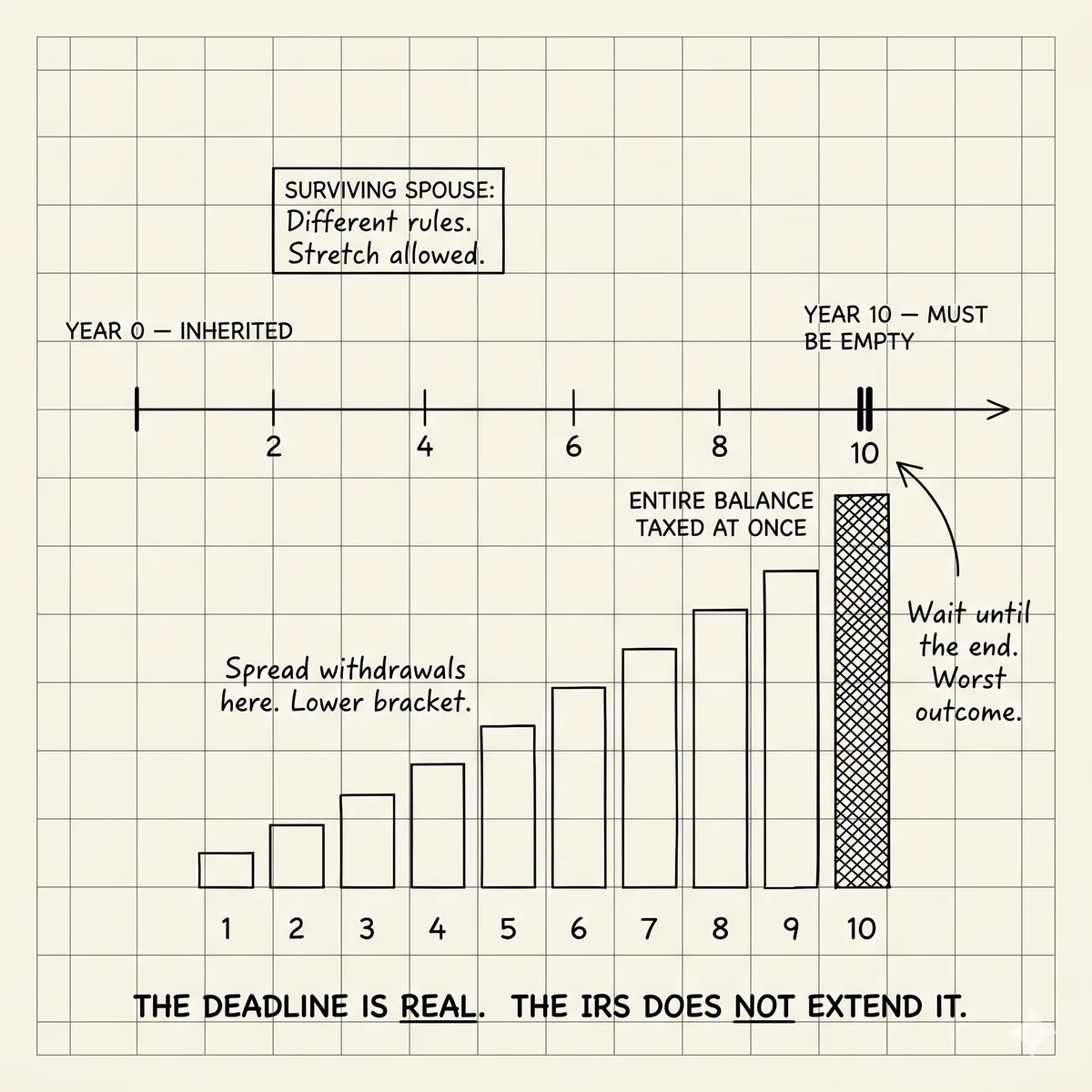
You inherited your father's traditional IRA nine months ago. $480,000. You called the brokerage, updated the account to your name, and then put it out of your mind because you had enough to deal with. Here is the thing: a 10-year clock is running, and what you do with it each year matters far more than most people realize.
The inherited IRA rules changed fundamentally in 2020. The SECURE Act, and its follow-up SECURE Act 2.0 in 2022, eliminated a strategy called the "stretch IRA" for most non-spouse inheritors. Under the old rules, you could stretch distributions over your entire life expectancy, deferring taxes for decades. Under the new rules, most non-spouse inheritors must empty the account within 10 years of the date of death.
This change created a widespread misunderstanding. And the misunderstanding costs people significant money in unnecessary taxes.
The Mistake Most People Make
When they hear "10-year rule," most inheritors think: I have 10 years. I'll leave it alone and take it all out in year 10.
This is the wrong approach. It can create an enormous tax problem in a single year.
Walk through the numbers. Suppose you inherited a $480,000 traditional IRA. You leave it invested for 10 years at a 6% annual return. By year 10, it has grown to approximately $860,000. You must withdraw the entire balance by December 31 of year 10.
That $860,000 is ordinary income. Added to your salary. If you earn $185,000 from your job, you now have $1,045,000 in taxable income that year. At current rates, the marginal federal rate on that combined income reaches 37%. Effective federal tax on that $860,000 withdrawal is likely in the 30-35% range. You might also owe state income tax.
Compare that to spreading withdrawals evenly. If you take roughly $48,000 per year from a $480,000 starting balance, keeping the rest invested, you never push your marginal rate into the highest brackets. You pay taxes in the 22-24% range rather than 35-37%. Over 10 years, the tax savings on proper withdrawal planning can easily be $50,000 to $100,000 or more.
The 10-year rule doesn't require you to empty the account each year. It requires you to empty it by the end of year 10. Every year you have flexibility in how much you take. The right question is not "when do I have to take it out?" but "how much should I take out each year to minimize lifetime taxes?"
Who the 10-Year Rule Applies To
The 10-year rule applies to "non-eligible designated beneficiaries" who inherit from someone who died after December 31, 2019. In plain language: this applies to you if you inherited a traditional IRA or 401(k) from a parent (or other non-spouse) who died in 2020 or later.
There are exceptions. If you fall into one of these categories, the old stretch-IRA rules may still apply to you:
- Surviving spouse. A spouse who inherits an IRA can treat it as their own IRA, roll it into their own account, and defer distributions until their own required minimum distribution age (currently 73). The 10-year rule does not apply to spouses.
- Minor children of the deceased. Minor children can use the stretch method until they reach the age of majority (typically 21, but varies by state). After that, the 10-year clock starts.
- Disabled or chronically ill beneficiaries. Specific IRS criteria apply. If you qualify, you can stretch distributions over your lifetime.
- Beneficiaries no more than 10 years younger than the deceased. A sibling or other person within 10 years of age can use the stretch method.
- Inherited before 2020. If you inherited before January 1, 2020, you are likely still under the old rules.
If none of these exceptions apply (which is the case for most adult children who inherit from parents), the 10-year rule governs.
An Important Update for 2023 Through 2025
There has been genuine confusion about whether annual withdrawals are required during the 10-year period. The IRS issued proposed regulations in 2022 that suggested annual required minimum distributions (RMDs) were required if the original owner had already started taking their own RMDs. This created significant confusion.
The IRS subsequently waived penalties for those who didn't take annual distributions in 2021, 2022, 2023, 2024, and 2025 while the rules were being finalized. Final regulations were expected to clarify the situation. As of 2026, you should confirm with a CPA or the IRS guidance current at the time of your decision whether annual RMDs are now required for your specific situation.
Regardless of whether annual RMDs are technically required, taking strategic annual distributions is almost always the right financial decision for tax reasons. The waiver period simply meant you weren't penalized for not doing it. You still should.
How to Think About Annual Withdrawals
The goal is to spread the tax burden over 10 years in a way that keeps you out of higher marginal brackets. This is a modeling exercise, not a formula. It depends on your income in each of the 10 years.
Start with a simple question: in a given year, how much income do I have from other sources (salary, investments, other income)? How much additional ordinary income can I add before crossing into the next tax bracket?
For 2026, the 22% bracket runs up to $103,350 for married filing jointly. The 24% bracket runs up to $197,300. The 32% bracket runs up to $383,900. The 35% bracket runs up to $487,450.
If your combined salary income puts you at $200,000, you're at the top of the 24% bracket. An inherited IRA distribution of $50,000 would push $50,000 into the 32% bracket. That may be acceptable. A $400,000 distribution would push a large amount into 35%+ territory. That is avoidable with planning.
Consider years when your income might be lower: a sabbatical, a job transition, a year between jobs. Those years are good opportunities for larger inherited IRA withdrawals. Consider years when your income is unusually high: avoid large distributions if you're already in the top brackets.
The Roth IRA Exception
If you inherited a Roth IRA rather than a traditional IRA, the mechanics are different. Roth IRA distributions are generally tax-free (since the original contributions were made with after-tax dollars). The 10-year rule still applies to non-spouse inheritors of Roth IRAs, but there are no required annual distributions. You can leave the Roth IRA to grow tax-free for up to 10 years and take the distribution in year 10 entirely tax-free.
In this case, waiting until year 10 actually is the right answer (assuming you don't need the money earlier). The growth is tax-free, so the longer you leave it, the more you benefit.
What to Do Right Now
If you have an inherited traditional IRA, the steps are:
- Confirm the account is properly titled as an inherited IRA. It should read something like "John Smith IRA (deceased) FBO Sarah Mitchell as beneficiary." If it was rolled into your own IRA, that is a problem. Non-spouse inherited IRAs cannot be rolled into your own IRA without triggering a full taxable distribution.
- Note the date of death. The 10-year clock starts from the date of death, not the date you set up the inherited IRA account.
- Talk to your CPA before December of the first year. Decide whether to take a distribution in year one based on your income that year. Don't leave money on the table.
- Build a rough 10-year withdrawal plan. Even a simple spreadsheet showing your projected income per year and how much IRA distribution you could take at each tax bracket is better than no plan.
- Keep the money invested. Leaving an inherited IRA in cash or low-yield money market is a compounding mistake. You're going to pay taxes on it regardless. Let it grow in the meantime.
The inherited IRA rules are one of the areas where professional tax advice genuinely pays for itself. An hour with a CPA who understands this area can map out a 10-year plan that saves you meaningful money. The complexity is not in the concept. It is in the modeling.
NettWorth
Wondering how to act on the insights in the article? Click here to apply this framework to your own wealth portfolio.
NettWorth reads your actual documents and applies what you just learned to your specific accounts, balances, and timeline — not a hypothetical.
No charge if you cancel. Your data stays yours.
Continue Reading
Will I Owe Taxes on My Inheritance? (What Most Articles Get Wrong)
Federal estate tax, state inheritance tax, and income tax on inherited assets are three different things that almost every article conflates. Most inheritors owe nothing on the inheritance itself. What catches people by surprise is what the assets generate afterward.
The Green Card Exit Tax: Why Your Biggest Immigration Upgrade Has a Hidden Cost
After 8 years, a green card isn't just an immigration status — it's a tax position with a specific cost to exit. The deemed-sale rule applies to your entire portfolio on the day you leave. Most NRIs don't discover this until they want to move back.
The 15-Year Tax Setup I Wish Someone Had Told Me
Rohit pulled up his 2009 W-2 not to look at the number — to look at the decisions he hadn't made yet. Wrong account type. Wrong entity structure. Wrong equity exercise timing. None of it was illegal. All of it was expensive. And none of it was fixable once the window closed.