The Complexity Tax: What Accounts in Three Countries Actually Cost You
"You track everything, but you control nothing." A friend said this during a call, and it stuck with me. Not because it was harsh. Because it was true.
She manages her finances carefully. She knows her balances. She could tell you, roughly, what everything is worth. What she can't tell you is whether any of it is arranged the way it should be, or whether she is just keeping the machine from breaking.
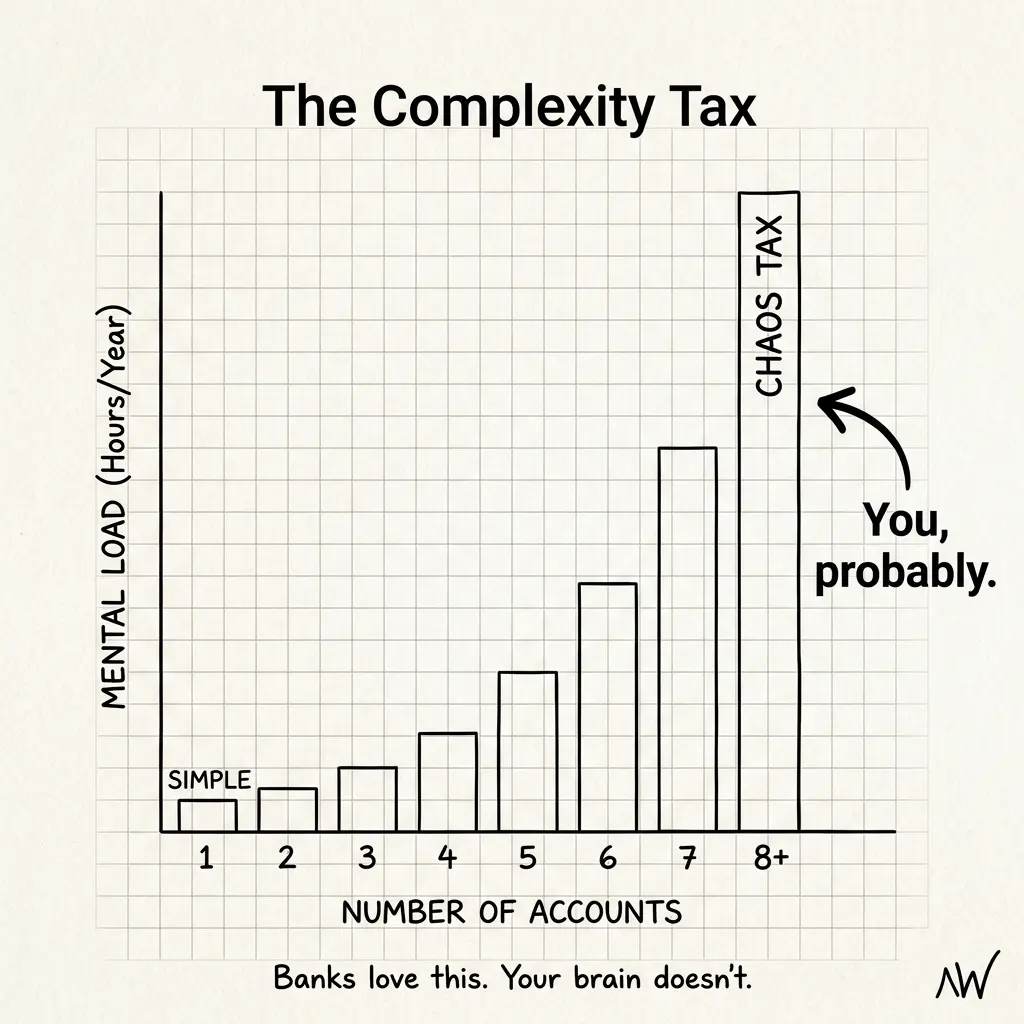
Her setup is ordinary for anyone who has lived in more than one country. A typical cross-border household in Europe holds a salary account and savings where they live now, a pension with the current employer and another from a previous country, NRE and NRO accounts in India, a PPF that was never closed, Indian mutual funds, perhaps a flat in Bengaluru with a tenant in it. Ten to fifteen accounts in three countries is normal. Each one is fine on its own. Together they cost money that never shows up on any statement.
Where the Cost Hides
Tax withheld that nobody reclaims
Indian banks deduct tax on NRO interest at the domestic non-resident rate, around 30% plus surcharge and cess. The treaty between India and most Western European countries allows India far less. The difference is recoverable only if you give the bank a tax residency certificate and Form 10F, or file an Indian return and claim it back. Most people with an NRO account do neither.
Deadlines nobody is watching
The Dutch 30% ruling has a four-month application window. An Indian property sale needs a lower-deduction certificate before the sale, not after. Some pension options expire on your last working day. Each deadline lives in a different country's calendar, and none of them will remind you.
Accounts that go quiet
Under RBI rules, an Indian savings account with no customer-initiated transactions for two years becomes inoperative. Deposits unclaimed for ten years move to the RBI's Depositor Education and Awareness Fund. The money is still yours, and the RBI runs a portal, UDGAM, to help people find it. That a central bank needed to build a search engine for forgotten deposits says how common this is.
Reporting that doesn't match
Your country of residence wants to know about your foreign accounts. The Netherlands values them on 1 January for Box 3. France wants each one declared on Form 3916, with a €1,500 penalty per account left off, per year. Indian banks report non-resident accounts under the Common Reporting Standard, so the tax office often knows about an account before you remember to declare it.
Cash buffers in every currency
Each country gets its own emergency cushion, because moving money between them is slow and costs 2 to 4% at a bank. Three cushions earning next to nothing is a real cost, and so is the exchange rate markup on every transfer between them.
The Decisions That Don't Get Made
The fees and the reclaimable tax are the visible part. The larger cost is what fragmentation does to decisions. When the picture is spread across three countries and two tax years, nobody can see the whole of it, so nobody acts on the whole of it. The PPF that should have been reconsidered stays. The NRO balance that should have come out within this year's limit doesn't. The pension in the country you left is never looked at again.
Every professional you work with sees one country's part of this. They are doing their job. The job of seeing all of it was never in anyone's engagement, which is why it so rarely gets done.
A useful first count
List every account, policy and property you hold, in every country, with the country it sits in and the last time you made a decision about it rather than just looking at it. Most people find the second column is the uncomfortable one.
The same problem from the household side, and who usually ends up carrying it, is in the family CFO.
Do you know how many accounts you hold across countries, and which ones are costing you?
A blog post can tell you the rule. It can't tell you what it means for your accounts, your dates, your numbers. That's a conversation, not a search result.
Book a call and get answersNettWorth
Wondering how to act on the insights in the article? Click here to apply this framework to your own wealth portfolio.
NettWorth reads your actual documents and applies what you just learned to your specific accounts, balances, and timeline — not a hypothetical.
No charge if you cancel. Your data stays yours.
Continue Reading
The Document Problem: What Your Family Won't Find If Something Happens to You
When my grandmother died in Bangalore, the will and the assets didn't match, and she had lived in one city all her life. A cross-border household's estate is spread across documents in several countries, a nominee is not an heir under Indian law, and EU and Indian succession rules can each claim a piece of the same estate.
The Family CFO: When Tracking Everything Still Leaves You Blind
She tracks every account, every month, and still can't answer the question that matters: can we pay for medical school and retire? Her household lives in one country. The family CFO of a cross-border household does the same job with two tax years, three languages and two sets of professionals who never speak to each other.
Your FIRE Spreadsheet Doesn't Work When Your Assets Live in Three Countries
My spreadsheet started as a list of what I own. It grew a tab for every question, and broke on the only one that matters: when is it enough? The 4% rule comes from US market history; across seventeen countries it survived the worst case in only four. For a household spending euros with assets in rupees, currency, withdrawal tax and money that can't move freely break the model.