Concentrated Position Paradox: Managing Single-Stock Wealth Risk
Quick Answer
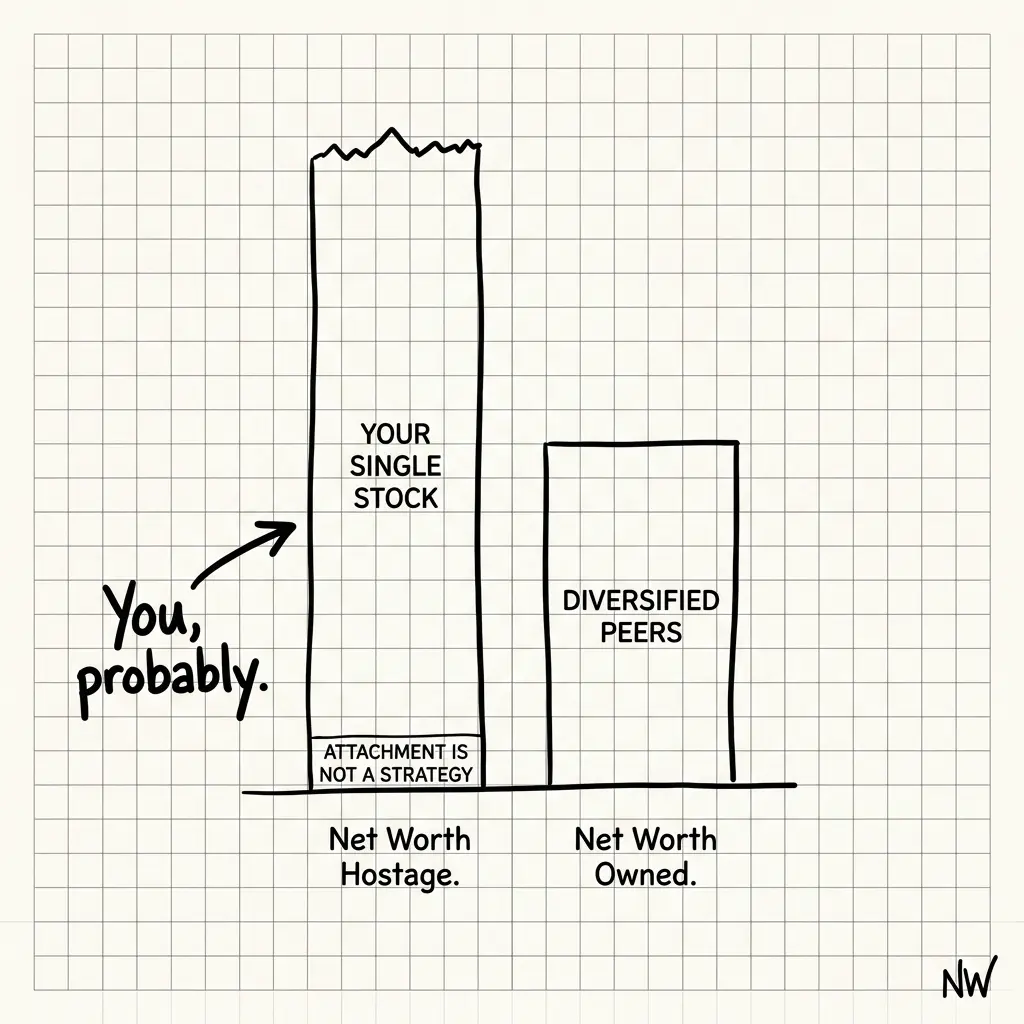
The Concentrated Position Paradox: You work for a company whose stock is your largest asset. You believe in it (you chose to work there). But you're also running position risk you didn't intend to take. A $300K earner with 30% of net worth in employer stock is both "employee" and "accidental venture capitalist." The paradox is that diversifying feels like betrayal, yet staying concentrated feels like recklessness. The real cost of concentration—not just volatility but behavioral lock-in—is larger than most people calculate.
You joined a well-known tech company five years ago. Your RSUs vested over time. Today, your net worth is $1.2M, of which $360K is in your employer's stock—your largest single holding. You trust the company. You work there. But you also know what happens when concentrated positions unwind.
This is the Concentrated Position Paradox: the tension between conviction (you believe in your company) and concentration risk (no single asset should represent 30% of your portfolio). For HENRYs with substantial equity comp, this paradox is not theoretical—it's structural.
Why Concentration Happens (And Why It Feels Justified)
Concentration at your income level isn't recklessness. It's rational given the constraints:
1. Equity Compensation as Default Saving
You earn $300K salary. You receive another $100K–$300K in annual equity (RSUs, options). Over 5 years, that's $500K–$1.5M in company stock. You didn't actively decide to be 30% concentrated. The equity comp structure defaulted you into it. By the time you realize the concentration, it feels entrenched.
Data: 67% of HENRYs with tech equity report that employer stock is their single largest holding, despite intellectual agreement that 10–15% concentration is optimal.
2. The Conviction Trap
You work at the company. You see the product roadmap. You attend leadership presentations. You have information most investors don't have. That conviction—"I know this company better than the public market does"—creates an emotional attachment that justifies holding more than you should.
The irony: Employees at the company with the *best* information paradoxically take the *most* risk. Data from insider trading records shows executives are often more concentrated than the general shareholder base.
3. The Tax Cost of Diversification
You bought/vested at $50/share. The stock is now $180/share. Selling to diversify means realizing $130/share in gains = $39,000 in taxable income (at your 32% marginal rate, that's ~$12,500 in taxes). For a $150K vesting package, diversifying costs $12,500 in taxes *plus* the year-round hassle of tracking lots.
The tax friction means you hold longer than optimal. That's a cost too—just delayed and hidden.
4. The Peer Comparison Distortion
Everyone around you at work is concentrated in the same stock. Your team is concentrated. Your manager is concentrated. Your peers in the same role are concentrated. The crowd reinforces the position. "Everyone here believes in the company" becomes a proxy for "this concentration is normal."
It's normal *within your peer group*. It's also a systematic risk. When the company hits trouble (product shift, market downturn, leadership change), your entire HENRY cohort faces the same shock simultaneously.
The Real Cost of Concentration
The textbook cost of concentration is volatility: a 40% drop in stock price means a $144K loss on your $360K position. That's material. But there's a second cost that's often overlooked:
Behavioral Lock-In
When 30% of your net worth is in one stock, every decision you make becomes filtered through "what's best for this position?" Rather than optimizing for your personal life, you optimize for the stock price. You stay at a job longer than you'd otherwise choose. You defer moves to different geographies. You avoid speaking critically about the company publicly. You've become a hostage to the position.
This behavioral cost might be larger than the volatility cost:
Opportunity Cost of Job Inertia
A different role at a different company might pay 25% more. But switching loses the unvested equity. A $150K annual grant vesting over 4 years is $600K in future value. Leaving now means forfeiting $300K of that. The concentration trap locks you in to the current role, even if a better opportunity exists elsewhere.
Income Correlation Risk
Your salary comes from the company. Your wealth comes from the company. A single company news cycle (missed quarter, competitive threat, leadership shakeup) can simultaneously affect your job security *and* your net worth. You're running concentrated income + concentrated assets.
Liquidity Timing Pressure
If you need liquidity (home purchase, major expense), you sell the concentrated position. Most people wait too long to build emergency reserves because they're underwater on the "correct" time to sell the stock. When they finally need liquidity, they sell at a bad time.
The Data on Concentration Risk
Tech Workers with 20%+ Concentration
72% of tech workers with RSU compensation end up with 20%+ of net worth in employer stock. Most didn't plan for that outcome.
Average Time to Diversify Below 15%
4.2 years after recognizing the concentration. The delay is usually driven by tax friction, not conviction.
Negative Stock Performance Post-Recognition
Employees who recognize they're over-concentrated often exit (sell) at sub-optimal times. The stock price decline is what triggers the realization of excessive concentration. Then they sell during the decline.
Tax Impact of Delayed Diversification
Waiting 4+ years to diversify means the unrealized gains grow. When you finally sell, the tax bill is 50%+ larger than it would have been if you'd diversified gradually from year 1.
The Questions That Matter
What percentage of your net worth is employer stock?
If it's 15% or less, you're diversified. 15–25% is moderate risk. 25%+ is concentrated enough that it should influence other decisions (career, geography, risk tolerance).
How much of your annual wealth-building goes into the same stock?
If 60%+ of your annual equity compensation goes into employer stock, the concentration is structural. You're defaulted into it, not choosing it.
What would the tax hit be to diversify today?
Calculate the unrealized gain on your largest position. Multiply by your marginal tax rate. That's the cost of waiting another year. Is conviction in the stock worth that tax drag?
Would you choose to buy more of this stock with new money?
If the answer is "no," you're over-concentrated relative to your true conviction. The position is a legacy (from RSU grants) rather than an active choice.
The Paradox Resolved
The Concentrated Position Paradox is resolved not by choosing conviction or safety, but by making concentration intentional:
1. Separate Your Conviction from Your Position Size
You can believe in the company (good product, strong team, valuable mission) and still limit your exposure to 10–15%. Conviction doesn't require concentration. Diversified portfolios outperform concentrated ones over multi-decade timescales.
2. Diversify Gradually to Minimize Tax Friction
Rather than a single large sale, diversify 10–15% of the position each quarter over 1–2 years. Spread the gains over multiple tax years. Use the rule: "Every vesting event is an opportunity to reduce concentration." Sell 30–50% of each vest to diversify.
3. Use Tax-Smart Strategies
Stagger diversification across tax years. Consider using losses in your brokerage account to offset gains (tax-loss harvesting). If you have significant gains, diversifying into a self-directed brokerage account allows you to take losses later to offset the gains.
4. Detach Career Decisions from Position Decisions
Make job decisions based on career fit and compensation, not on unvested equity. Unvested equity should influence *how* you diversify, not whether you stay at a job that's no longer right for you.
The concentration isn't the problem. The unconscious concentration is.
Once you see the position size, you can make intentional decisions about it. You can hold conviction in your company and limit your exposure to 12%. You can acknowledge the tax cost of diversification and still decide to pay it. The paradox dissolves the moment you make the choice explicit.
If 25%+ of your net worth is in a single company stock—
You're not taking a calculated risk. You're defaulted into one. That distinction matters.
NettWorth
Wondering how to act on the insights in the article? Click here to apply this framework to your own wealth portfolio.
NettWorth reads your actual documents and applies what you just learned to your specific accounts, balances, and timeline — not a hypothetical.
No charge if you cancel. Your data stays yours.
Continue Reading
Locked In Twice: RSU Concentration When You're Also on a Visa
Arun had $900K in unvested RSUs and 60 days to find a new H1B sponsor. His liquid net worth was $140K. Job loss and immigration risk are perfectly correlated for H1B workers — and the standard RSU playbook doesn't account for this.
Equity Comp Decision Stack: ISOs, RSUs, NSOs, QSBS
Six decision windows per year: ISOs, RSUs, NSOs, and QSBS must be coordinated. Master the decision order that saves $100K+ in the same tax year.
RSU Disposition: Sell to Cover vs. Same-Day Sale
Your company defaults to 22% withholding. If you're in 37% bracket, that's a $30K surprise every April. Learn the right RSU disposition strategy that matches your tax bracket.