Cross-Border Wealth Assessment

You live in one country.
Your money lives in several.
Is anyone managing the full picture?

Most cross-border professionals have built financial lives across jurisdictions one account at a time. The compliance gaps, the unconsolidated retirement picture, the FX exposure — they accumulate quietly until something forces the reckoning. If your picture includes NRE/NRO accounts, a UK SIPP, a German Riester, or a flat back home that no US advisor wants to discuss — this was built for that situation.

  • Your full asset picture consolidated across every jurisdiction — one net worth number
  • Your FBAR and Form 8938 exposure flagged against your current account structure
  • Your foreign pension and US retirement accounts modeled together — one retirement date

Four questions. One number that tells you if you're ahead or behind.

Your Wealth Clarity Report
4 minutes. Personalized results. No advisor required.
Start your assessment →
Free · Private · Takes 4 min

You're probably in one of these situations

H-1B or L-1 at a US tech company

RSUs vesting in the US, NRE/NRO accounts in India. Nobody has looked at both sides of the picture at the same time.

American abroad — London, Singapore, the Netherlands

Your US brokerage is still open. Your UK pension or CPF is growing. You're not sure which tax credits to claim where.

Returning NRI with an RNOR window

You have two to three years where foreign income isn't taxed in India. Most people find out about this window after it closes.

On a global assignment

Your employer handles tax equalization on your salary. Nobody handles the pension from your last role, the flat back home, or what happens after you repatriate.

If any of these are you, this was built for your situation specifically.

2.4
Separate financial ecosystems the average user maintains before completing our cross-border assessment — never previously consolidated
NettWorth assessment data
$10,000
Per-account FBAR non-filing penalty — starting point for innocent omissions
US Treasury / FinCEN
35%
Of US taxpayers with foreign accounts had at least one FBAR compliance gap in 2023
Treasury OIG 2023
From the NettWorth Research Library
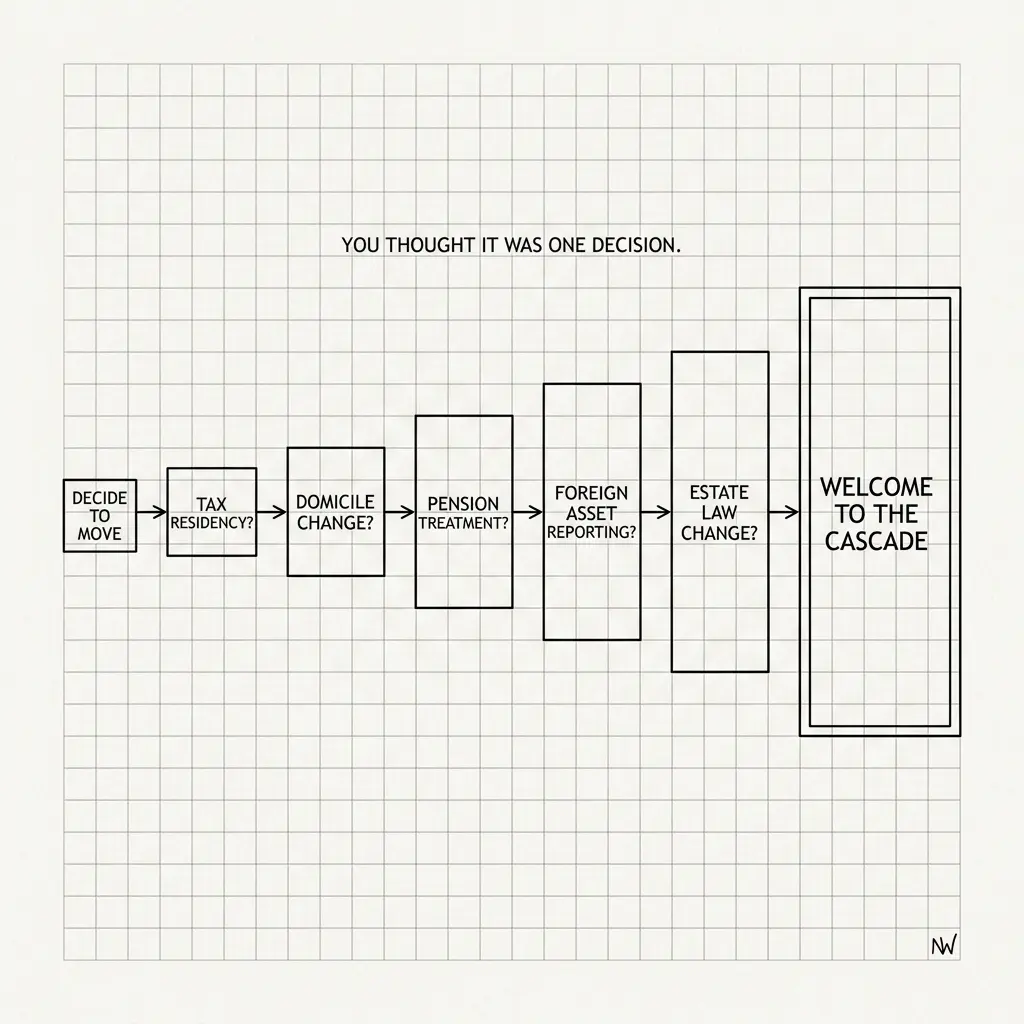
The Cross-Border Moment
The financial inflection point that every professional moving between countries faces — and almost nobody plans for in advance.
The RNOR Window
The RNOR Window
The most valuable 2-year tax window available to returning NRIs — and why it has to be planned before you pack.
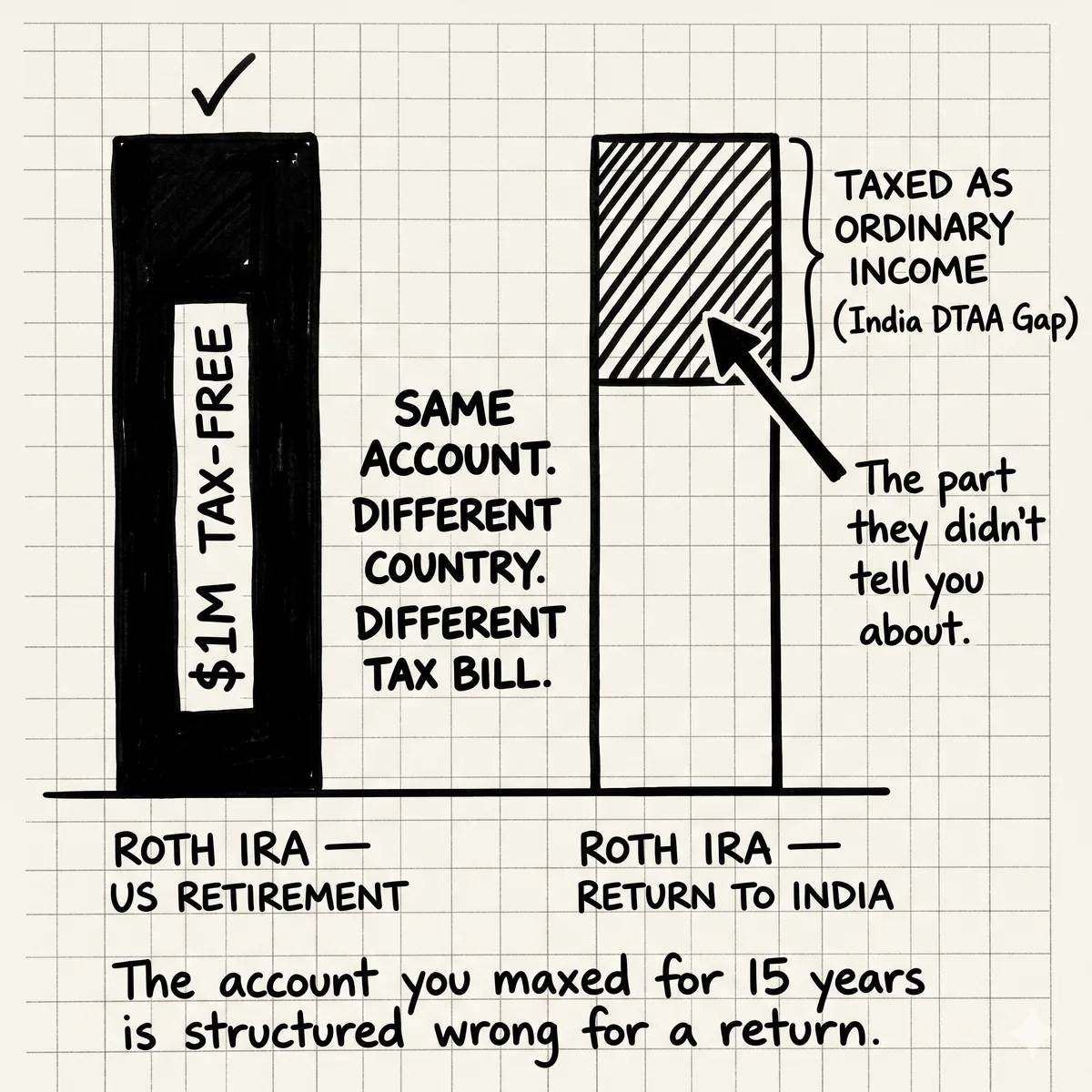
The Roth IRA NRI Trap
Why the standard Roth IRA advice breaks down for Indian-Americans — and what the actual decision looks like.
Questions & Answers

Do I need to file FBAR if I have accounts in another country?

Yes, if the aggregate value of all foreign financial accounts exceeds $10,000 at any point during the calendar year, FinCEN Form 114 (FBAR) is required by April 15 (with automatic extension to October 15). This is separate from FATCA Form 8938, which has different thresholds and applies to specified foreign financial assets. Non-willful failure penalties start at $10,000 per account per year; willful failure penalties can reach the greater of $100,000 or 50% of the account balance.

How is a UK pension treated for US tax purposes?

UK workplace pensions and SIPPs are generally taxable in the US, with the US-UK tax treaty (Article 17) providing some relief. The complexity: contributions to UK pensions aren't deductible in the US, creating potential double-taxation. Many cross-border professionals have significant unrecognized pension assets — the UK pension exists in British pounds in a British institution, and no US-facing financial tool consolidates it with US retirement accounts. This creates a systematic undercount of total retirement assets.

What is the wealth impact of holding assets in multiple currencies?

Currency risk is the most underestimated factor in cross-border net worth. A 10% USD/GBP movement creates a 10% swing in the USD value of UK assets — with no market movement required. Over a decade, unhedged multi-currency exposure can erode effective purchasing power by 8–15%. True net worth for a cross-border professional requires currency-normalized consolidation to a base currency, updated regularly.

How is PPF (Public Provident Fund) treated for US tax purposes?

PPF is not automatically treated like a Roth IRA. The IRS position is ambiguous — some practitioners treat it as a foreign trust requiring Form 3520; others report only distributions. The asymmetry matters: most NRIs have been contributing for years without knowing their US reporting obligations. PPF also appears on the FBAR threshold calculation if combined with other foreign accounts, which many people miss. NettWorth flags your India-side account structure against your current FBAR filing profile so your CPA has the complete picture before filing.

What is the RNOR window and why does it need to be planned before returning to India?

RNOR (Resident but Not Ordinarily Resident) is a 2–3 year status window after returning to India during which foreign income — including 401k distributions and US brokerage gains — may not be taxable in India. It's the most valuable tax window available to returning NRIs, and it has to be planned while you're still in the US. Decisions about Roth conversions, 401k distributions, and US property sales need to happen before your RNOR window opens, not during it. Most NRIs only discover this after they've moved — when it's too late to take full advantage.
Both directions covered

Moving into the US, or leaving it?

This page covers professionals moving to the US and multi-jurisdiction portfolios. If you're an American living abroad — still filing US returns, still subject to FBAR, still taxed on worldwide income — there's a dedicated assessment for your direction.

For Americans Living Abroad →H-1B Specific Assessment →