You're Probably Planning for the Wrong Retirement Country
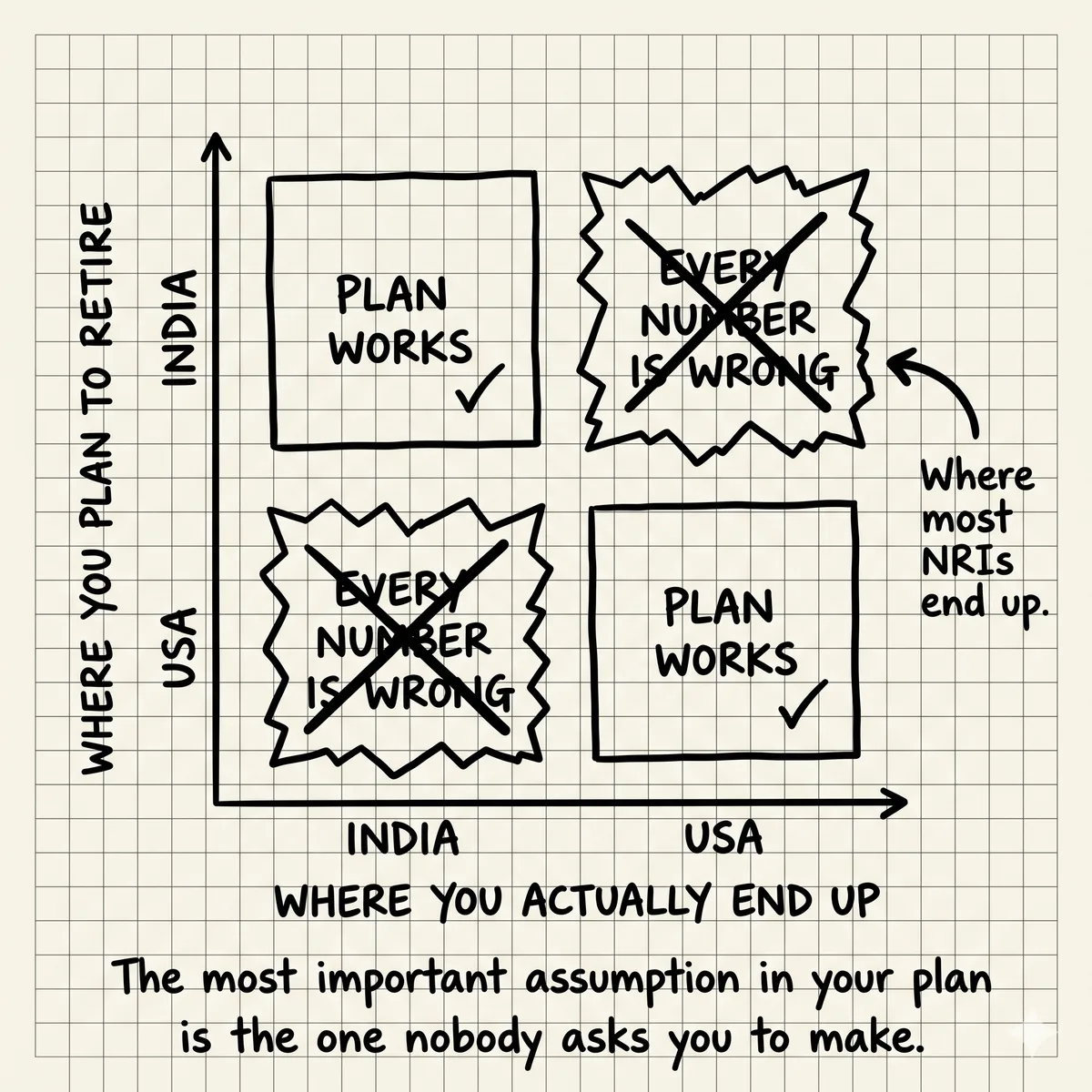
Ask someone who moved from Bengaluru to Amsterdam ten years ago where they will retire. The answer is usually "probably India." Then ask what their pension, their savings and their plan assume. The answer is usually "the Netherlands," because nobody ever told the plan otherwise.
Every retirement plan rests on a location. It sets the currency you will spend in, the cost of healthcare, which state pensions you can claim, and which country taxes what you draw. For someone who has lived in one country all their life, the assumption is silent and correct. For a household that crossed a border, or whose two partners come from two different countries, it is silent and very often wrong.
Leaving the question open feels like keeping options open. It isn't. If you haven't decided, the plan decides for you, by defaulting to wherever your adviser, your pension provider or your spreadsheet happens to be.
What the Answer Changes
Which pensions you can claim, and how
Inside the EU, the EEA and Switzerland, Regulation (EC) No 883/2004 adds together the years you worked in each country, and each country pays its share of your state pension wherever in that area you live. Move outside it and the rules depend on bilateral agreements instead.
The national rules underneath are not alike. The Dutch state pension (AOW) builds at 2% for every year you are insured in the Netherlands, so a full one needs fifty years; ten years in Amsterdam earns about a fifth of it. Germany's statutory pension needs at least five years of contributions before it pays anything. These numbers don't move when you change your mind about where to retire, but what they are worth to you does.
The Swiss case makes the point sharpest
If you leave Switzerland for good to live in a country outside the EU and EFTA, India included, you can take your entire occupational pension as cash. Move to an EU or EFTA country instead and the mandatory part stays locked in a vested benefits account if you are covered by that country's pension system, and can be drawn at the earliest five years before Swiss retirement age. The same pension, the same balance: how much of it you can touch depends on where you go next.
Who taxes what you draw
Most tax treaties give the right to tax a private pension to the country where you live when you receive it, not the country where you earned it. A pension built in Germany and drawn in Bengaluru is, broadly, an Indian tax question. Once you are fully resident in India, India taxes your worldwide income, so every European pension and account comes into the Indian return. The first two or three years back can be different, which is what the RNOR window is about.
What leaving costs on the way out
Some countries settle accounts when you leave. The Netherlands issues a protective assessment on your pension and annuity rights when you emigrate, and collects it if you commute or surrender them within ten years. That is a cost of retiring somewhere else that only exists if you built your pension in the Netherlands, and it shapes which vehicles you should be saving in now.
Three Ways It Goes Wrong
Plan for India, stay in Europe. The plan undersaves in euros because it assumes Indian costs. Indian assets are kept as the retirement base, then turn out to be in the wrong currency for the life you actually lead. European pension years were treated as a side benefit and are short of what a European retirement needs.
Plan for Europe, return to India. Savings went into vehicles that make sense for a European retiree and are awkward to unwind from India: locked pensions, annuity products with exit charges, tax-advantaged accounts whose advantage stops at the border. The return happens, and the money doesn't follow cleanly.
Two partners, two home countries. One of you assumes India, the other assumes France or Spain or Sweden, and the plan assumes neither. This is the most common version, and the least discussed, because the question feels personal rather than financial. It is both.
You Don't Have to Decide. You Have to Choose What to Assume.
Nobody needs to know at forty where they will live at sixty-five. What a plan needs is an explicit base case, the costs of switching away from it, and the decisions that should be made the same way whichever way it goes. Those last ones are usually most of them. The few that depend on the answer are the ones worth getting right first, because they are the ones that can't be reversed later.
The spreadsheet version of this problem, and why it breaks, is in your FIRE spreadsheet doesn't work across three countries.
Does your plan know which country you're retiring in? Do you?
A blog post can tell you the rule. It can't tell you what it means for your accounts, your dates, your numbers. That's a conversation, not a search result.
Book a call and get answersNettWorth
Wondering how to act on the insights in the article? Click here to apply this framework to your own wealth portfolio.
NettWorth reads your actual documents and applies what you just learned to your specific accounts, balances, and timeline — not a hypothetical.
No charge if you cancel. Your data stays yours.
Continue Reading
The Family CFO: When Tracking Everything Still Leaves You Blind
She tracks every account, every month, and still can't answer the question that matters: can we pay for medical school and retire? Her household lives in one country. The family CFO of a cross-border household does the same job with two tax years, three languages and two sets of professionals who never speak to each other.
Moving Back to India From Europe: The RNOR Window and the Exits That Come Before It
RNOR keeps most foreign income out of Indian tax for two or three years after you return, but only income first received outside India. Before it starts, the Netherlands, Germany and Switzerland settle their own claims as you leave: protective assessments, exit tax, and pension cash-out rules. Those are the decisions you can't undo from Bengaluru.
The Document Problem: What Your Family Won't Find If Something Happens to You
When my grandmother died in Bangalore, the will and the assets didn't match, and she had lived in one city all her life. A cross-border household's estate is spread across documents in several countries, a nominee is not an heir under Indian law, and EU and Indian succession rules can each claim a piece of the same estate.